
Still Paying for Your Big Fat Indian Wedding? How to Settle That Loan and Start Fresh

The wedding is over. The photos are framed. The flowers are long gone. But the EMIs? They are very much still here. At Settle My Loan, through our 45 Days Challenge, we see this story more often than you would think. Couples who celebrated the best day of their lives and then spent the next three to five years quietly paying for it, month after month, while their shared financial goals kept getting pushed further away. If you are still carrying unsecured credit obligations from a wedding loan and the repayment is becoming harder to manage, this blog is for you. Here is what your options look like, and how loan settlement can help you close that chapter for good.
Key Takeaways
- The average wedding loan size in India now stands at ₹15.5 lakh and many couples are still repaying years after the celebrations ended. wedmegood
- Wedding loan interest rates in India can reach up to 36% annually, meaning the total repayment amount can far exceed what was originally borrowed. lokmattimes
- If your outstanding wedding loan balance has become difficult to repay, loan settlement is a legal, structured option worth exploring.
- Loan settlement does not mean ignoring the loan, it means negotiating with the lender to close the account for a reduced, mutually agreed amount.
- The Settle My Loan 45-Day Loan Settlement Challenge gives borrowers a clear, guided path from outstanding balance to resolution.
Also Read
- What Is Loan Settlement and How Does It Work in India?
- How Loan Settlement Affects Your CIBIL Score And How to Rebuild It
How Did We Get Here? The Reality of Wedding Loans in India
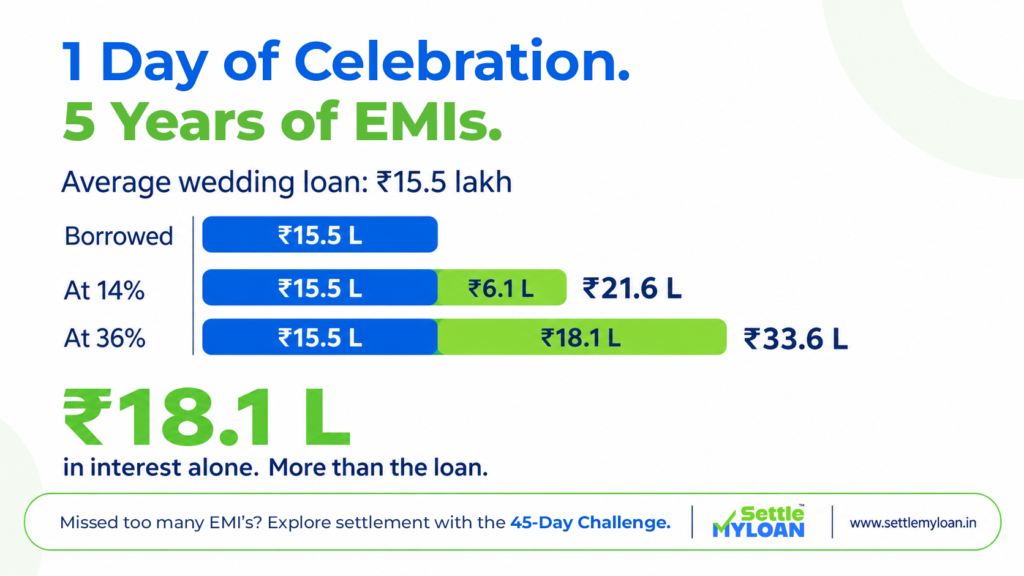
Indian weddings are unlike anything else in the world and they come with a price tag to match.
The all-India average budget for a wedding has reached ₹39.5 lakh, while destination weddings see an average spending of ₹58 lakh. According to Bloomberg, India’s weddings generate an estimated $130 billion in annual spending or 3.25% of the country’s 2025 nominal GDP. outlookmoneybusinesstoday
For families who cannot fund this from savings alone, the answer is often a personal loan. Wedding loans of ₹1–5 lakh are becoming increasingly common, and the average wedding cost now ranges between ₹10–25 lakh. businesstoday
The problem is not the loan itself. The problem is what happens after the wedding, when two people are building a new life together and a chunk of their combined income is already committed to paying for the celebration that started it.
Taking a wedding loan without proper financial planning can lead to a debt trap, especially at the start of married life. The burden of repaying high-interest loans can impact savings for essential future goals.
If this sounds familiar, you are not alone and more importantly, there is a way forward.
Is Your Wedding Loan Becoming Unmanageable? Here Are the Signs
Not every wedding loan becomes a problem. But some do, especially when life after the wedding does not go exactly as planned.
Watch out for these signs:
- You are only making minimum payments and the outstanding balance is barely moving
- One or both partners experienced a job change, pay cut, or unexpected expense after the wedding
- You have missed one or more EMIs and lenders have started calling
- The loan repayment is coming in the way of saving for a home, children, or emergencies
- You have started using credit cards to cover monthly expenses because the EMI is eating into your income
If any of these sound familiar, your wedding loan has moved from “manageable” to “needs a plan.” And the sooner you act, the more options you have.
What Is Loan Settlement and Is It the Right Option for You?
What Does Loan Settlement Actually Mean?
Loan settlement is a legal process where, in genuine hardship cases, a borrower and lender mutually agree to close an outstanding loan account by accepting a reduced lump-sum payment (upto 70% reduction in some cases) instead of the full outstanding amount. The lender writes off the remaining balance, and the account is marked as “Settled” on your credit report.
This is different from defaulting where you simply stop paying with no agreement. Settlement is a negotiated, documented resolution that closes the account formally.
Settled vs Closed What Is the Difference?
| Status | What It Means | Credit Impact |
| Closed | Loan fully repaid as per original terms | Best outcome for CIBIL score |
| Settled | Loan closed for a reduced agreed amount | Temporary CIBIL impact, can be rebuilt |
| Defaulted | Payments stopped with no resolution | Worst outcome legal action likely |
A “Settled” status does impact your CIBIL score in the short term. But for borrowers who are genuinely struggling with repayment, settlement is far better than default and the score can be rebuilt over time with consistent financial behaviour.
Who Is Loan Settlement Right For?
Loan settlement is typically the right option when:
- The outstanding balance is significantly higher than what you can repay in the foreseeable future
- You are facing genuine financial hardship job loss, reduced income, medical emergency, or business downturn
- The loan has already entered default or irregular repayment
- You have a lump sum available either from savings, family support, or asset liquidation that is less than the total outstanding
If you are simply stretched but still managing payments, restructuring, debt management or prepayment may be better options. A specialist consultation will help you identify the right path.
How Does the Loan Settlement Process Work?
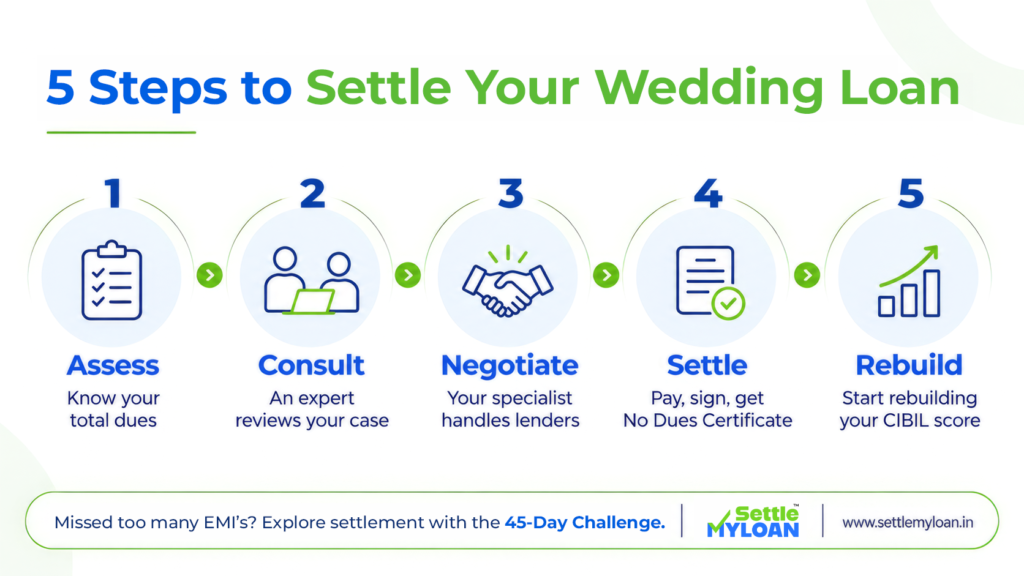
Step 1: Assess Your Full Financial Picture
Before anything else, get clear on the numbers. What is your total outstanding balance including interest and penalties? How many lenders are involved? Are there any accounts already in legal proceedings?
Step 2: Speak to a Loan Settlement Specialist
This is not a process to navigate alone. A specialist like the team at Settle My Loan will assess your situation, identify which settlement approach suits your case (One Time Settlement, Term Settlement, or Moratorium Period Settlement), and represent you through the entire lender negotiation process.
Step 3: Lender Negotiation Begins
Settlement advocates initiate communication with the lender, present documentation of your financial hardship, and propose a settlement amount. This is where having professional lender coordination matters, a settlement specialist knows what lenders are likely to accept and how to structure the offer.
Step 4: Settlement Agreement and Payment
Once the lender agrees, the settlement terms are documented in writing. You make the agreed payment, and the lender closes the account and issues a No Dues Certificate.
Step 5: Rebuild
With the outstanding balance resolved, you begin the next phase, rebuilding your credit profile and working toward the financial goals the loan was holding back.
Real-Life Case Study: How Rahul Haryan Cleared ₹33 Lakh and Started Over
Rahul Haryan, a 40-year-old entrepreneur from Mumbai, found himself with ₹32.95 lakh in unsecured credit obligations across multiple credit cards and a personal loan after the pandemic wiped out his business, his partners walked away, and he was left with all the liabilities, zero income, and no savings. Settle My Loan’s legal and paralegal team stepped in, took over all lender communication, stopped the harassment, and built a phased loan settlement plan based on his genuine financial hardship.
He settled for just ₹10.15 lakh, saving ₹22.79 lakh, a 69% reduction and walked away debt-free, with his dignity restored.
Read the full case study here.
The Settle My Loan 45-Day Loan Settlement Challenge – What Makes It Different?
Most people dealing with unsecured credit obligations do not act because the process feels overwhelming and open-ended. The Settle My Loan 45-Day Loan Settlement Challenge was built to solve exactly that.
Here is what makes it different:
- One point of contact – A dedicated settlement specialist manages all communication with your lenders, so you do not have to deal with multiple calls and notices
- A defined 45-day timeline – Not an open-ended process, but a structured programme with clear milestones
- Phased settlement planning – The approach is tailored to your specific lenders, outstanding amounts, and financial situation
- Legal protection the team handles legal notices and lender escalations so you can focus on rebuilding
The philosophy is simple: Settle, Rebuild, Thrive. Close the outstanding balance, rebuild your credit profile, and move toward genuine financial freedom, together.
Conclusion
A wedding loan is not a life sentence. The EMIs from a ₹20 lakh wedding loan can burden a couple for years, but that burden does not have to last forever. businesstoday
Whether your outstanding wedding loan balance is ₹3 lakh or ₹30 lakh, the most important thing you can do right now is stop avoiding it and start exploring your options. Loan settlement when approached with the right specialist and a structured process is a legal, documented path to resolution that lets you close this chapter and finally start the debt free life you got married to build.
The wedding was one day. Financial freedom is the rest of your life. Start working toward it today.
Take the Settle My Loan 45-Day Loan Settlement Challenge and find out what settlement could look like for your situation.
Book a Free Consultation, no obligation, just clarity.
Disclaimer: Participation, timelines and negotiation terms under the 45 Days Settlement Challenge are subject to eligibility, lender approval, and individual case circumstances. Terms and conditions apply
FAQ
Do Like and Share
Reviewed by our expert
Debt management and legal services expert specializing in creditor harassment handling, cheque bounce and Section 138 cases, MSME debt solutions, and unpaid invoice collection. Leads a panel of lawyers offering structured Debt Management Plans, settlements, and foreclosures, alongside legal and business set-up services for NRIs and foreign nationals.